


-
- News Center
- Related News
-
- Home > News > Company news >
- Aluminium Circle For Road Sign Blanks
Circular road signs are core safety facilities in municipal road networks, highways, and industrial and mining parks. The choice of base material directly determines the quality of project acceptance, outdoor service life, and overall maintenance costs. Aluminium circles, with their combined advantages of weather resistance, lightweight, and processability, have gradually replaced traditional galvanized steel sheets and plastic substrates, becoming the mainstream material for road sign projects worldwide. Haomei Aluminum has deep expertise in exporting aluminum materials specifically for transportation facilities, boasting years of experience and projects. Our clients are located in over 30 countries worldwide.
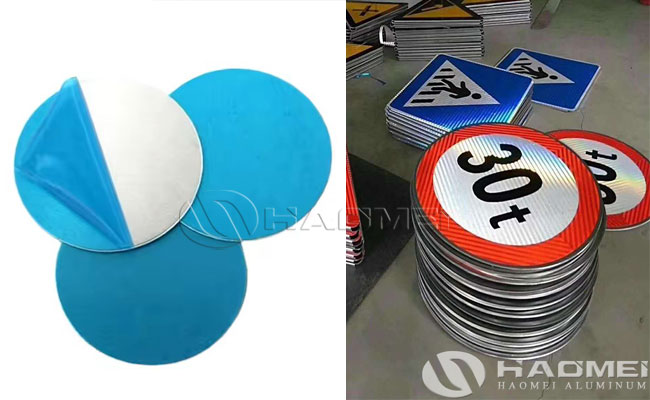
Compared to traditional metal substrates, the core value of aluminum circles in road sign scenarios is very clear.
Firstly, their lightweight advantage: aluminum's density is only one-third that of steel, reducing the weight of a circular sign of the same size by more than 60%, significantly reducing the risks and costs of high-altitude installation and hoisting, and also reducing the load on the sign post.
Secondly, it boasts long-lasting corrosion resistance. A dense oxide film naturally forms on the aluminum substrate surface, and after passivation treatment, it can withstand acid rain, coastal salt spray, and industrial exhaust gas corrosion. It requires no regular painting for rust prevention, and its outdoor service life can exceed 10 years, far surpassing that of ordinary galvanized steel sheets.
Thirdly, it offers excellent compatibility with reflective film. The aluminium circles have high flatness and a dense, non-porous microstructure. Engineering-grade and high-intensity reflective films adhere strongly after application, are not prone to peeling or delamination, and can maintain stable retroreflective visibility over a long period.
From an engineering perspective, aluminum circles for road signs have strict quality control standards. Flatness must be controlled within 0.5mm/m to avoid warping that could cause wrinkles in the reflective film and uneven nighttime reflection. Edges must be finely finished, free of burrs and flash, to prevent scratches during construction and stress corrosion later. Surface roughness must be uniform and controllable to match the bonding requirements of the pressure-sensitive adhesive for the reflective film. In terms of specifications, standard supply diameters cover φ600mm, φ800mm, φ1000mm, and φ1200mm, fully matching national standards and internationally accepted circular prohibition, instruction, and warning sign sizes. Thickness ranges from 1.0mm to 3.0mm; 1.0-1.5mm thickness is commonly used for small signs on municipal roads and in industrial parks, while 2.0-3.0mm thickness is recommended for large signs on highways and in coastal areas, meeting varying wind load strength requirements. The mechanical state generally adopts H14 semi-rigid condition, balancing structural rigidity and on-site machinability, with no significant plastic deformation during long-term outdoor service.
For different working conditions, precise matching of grade is necessary. For ordinary inland municipal roads and industrial park scenarios, 1060 H14 aluminum circles are preferred, meeting basic weather resistance standards and offering excellent overall cost-effectiveness, making them the mainstream choice for small to medium-sized projects. For corrosive environments such as coastal areas with high salt spray and chemical industrial parks, 3003 H14 aluminum-manganese alloy circles are recommended. The manganese alloying improves corrosion resistance by over 40% compared to pure aluminum, and no significant pitting corrosion was observed after over 1000 hours of neutral salt spray testing. For extra-large signs in areas with strong winds and extreme temperature differences, 5052 H32 aluminum-magnesium alloy circles can be used, offering higher structural strength, excellent deformation resistance, and suitability for harsh outdoor conditions.
Haomei Aluminum offers a full range of aluminium circle for road sign blanks, strictly adhering to ASTM B209 international standards. Surface treatments include chromium-free passivation and anodizing, with reflective film adhesion reaching Grade 0. Mainstream sizes are readily available, and non-standard specifications can be customized. Double-sided protective film and ocean shipping packaging are provided. Complete material testing reports and compliance documents are also available to meet the procurement and acceptance needs of various global transportation engineering projects.
- Haomei aluminum
- haomei Aluminium Plate