-
-
- Aluminum Foil For Heat Exchanger Fin
- Aluminum foil for heat exchanger fin is a core functional material in refrigeration and air conditioning, HVAC heat pumps, industrial cooling and automotive heat exchange. It achieves efficient heat transfer by increasing the heat exchange surface area, and its material quality directly determines the heat exchange efficiency, service life, and manufacturing cost of the entire device. As a core product line that Haomei Aluminum has cultivated for many years, we have achieved independent control over the entire chain, from alloy composition design and precision rolling control to surface treatment processes. Our aluminium foil for heat exchanger fin products cover all categories, including plain aluminum foil, hydrophilic aluminum foil, hydrophobic aluminum foil, and corrosion-resistant aluminum foils, suitable for various heat exchange scenarios from light civilian to heavy-duty applications. With stable batch consistency and adaptability to stringent operating conditions, we supply dozens of heat exchange equipment manufacturers worldwide, fully complying with international material standards such as ASTM B209 and EN 546.
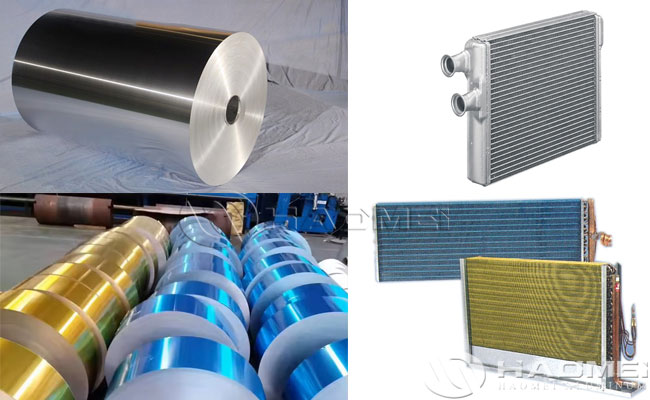
A reasonable alloy system selection is the fundamental prerequisite for aluminium foil for heat exchanger fin to adapt to different heat exchange conditions.
For ultra-thin finned and micro heat exchanger applications prioritizing high thermal conductivity, we select 1060 series pure aluminum substrate, strictly controlling the aluminum content to ≥99.6% with extremely low impurity element content. The substrate's thermal conductivity reaches over 235 W/(m·K), maximizing heat transfer efficiency.
For highly corrosive environments such as coastal areas with high salt spray and industrial exhaust gases, 3003 aluminum-manganese alloy is a superior solution. The solid solution strengthening effect of manganese simultaneously improves material strength and corrosion resistance, with significantly better creep resistance and surface powdering resistance than pure aluminum products.
8011 aluminum alloy balances formability, thermal conductivity, and overall cost. Its uniform and fine internal grain structure ensures stable performance in stamping, flanging, and stretching, making it a mainstream and common choice for residential air conditioners and general commercial heat exchange equipment. We can provide tailored solutions based on customer equipment conditions, forming processes, and cost targets.
Micron-level rolling precision and accurate state control ensure efficient fin forming and dimensional consistency. The common thickness range of aluminium foil for heat exchanger fins is 0.08mm–0.20mm. The small fin spacing and complex forming process place extremely stringent requirements on the uniformity of aluminum foil thickness, plate straightness, and mechanical properties. We employ a four-roll precision cold rolling mill paired with a closed-loop online thickness measurement system, ensuring stable thickness tolerance within ±2μm and plate straightness ≤5I. This effectively avoids production problems such as feeding deviation, edge cracking, and fin collapse during high-speed stamping. We also offer various tempering states, including O-state, H22, and H24. Through precise temperature-controlled annealing, we adjust the material elongation and hardness, matching different stamping dies and fin structure designs. This results in a stable mass production forming pass rate of over 99.5% for our customers, significantly reducing material waste and equipment downtime costs.
Differentiated surface treatment solutions specifically address the pain points of heat exchange attenuation under different operating conditions.
For routine drying and cleaning applications, plain aluminum foil are suitable, offering a direct heat conduction path and optimal overall cost.
In high-humidity refrigeration and dehumidification applications, hydrophilic coatings are recommended to quickly spread condensate, eliminate water bridging, and maintain stable heat exchange efficiency over the long term.
For frosting-prone scenarios such as low-temperature heat pumps and cold storage heat exchangers, hydrophobic coatings can be used to slow down frosting, shorten defrosting cycles, and reduce energy consumption fluctuations.
For highly corrosive industrial environments, customized composite anti-corrosion coating systems can be developed to effectively prevent corrosive media from contacting the substrate.
All surface treatments utilize chromium-free environmentally friendly passivation processes, complying with EU RoHS and REACH regulations. Coating adhesion achieves a grade 0 in the cross-cut adhesion test, showing no peeling or powdering under long-term temperature fluctuations.
Haomei Aluminum possess large-scale continuous production lines with single roll lengths reaching tens of thousands of meters, reducing customer roll changeover frequency and improving continuous production efficiency. Each batch of aluminium foil for heat exchanger fin products undergoes multi-dimensional testing, including conductivity, mechanical properties, coating performance, and salt spray testing, ensuring highly consistent product quality. Leveraging years of experience in export support, we can quickly respond to customized needs from different regions and industries, providing comprehensive support from material selection and process adaptation to after-sales technical support. This helps customers create highly reliable and cost-effective heat exchange equipment products, building core competitive advantages in the global market.
Return list
-
- COPYRIGHT (C)2020 Haomei Aluminum. All Rights Reserved.
-