


-
- News Center
- Related News
-
- Where to Buy 7075 Aluminium plate?
- 2015 Haomei Annual Meeting of the New Year
- If you're looking for
-
- Aluminum Strip For Air Conditioner Evaporators
In air conditioning refrigeration systems, the evaporator plays a crucial role in heat exchange. While traditional copper tube evaporators have dominated the market for many years, their high cost and heavy weight have become increasingly apparent. As a professional aluminum strips manufacturer, our produced aluminum strips for air conditioning evaporators use 1060 and 3003 series aluminum alloys as the core material, covering standard thicknesses from 0.12mm to 0.25mm. Widths can be customized from 200mm to 1200mm according to evaporator fin mold requirements. The finished product undergoes continuous degreasing and passivation treatment, complying with RoHS and GB/T 3880.1-2012 standards. As a core raw material for evaporator fins, the performance of this type of aluminum strip directly determines the heat exchange efficiency and operational stability of the air conditioner, and it is widely used in residential wall-mounted units, floor-standing units, and commercial central air conditioning systems.
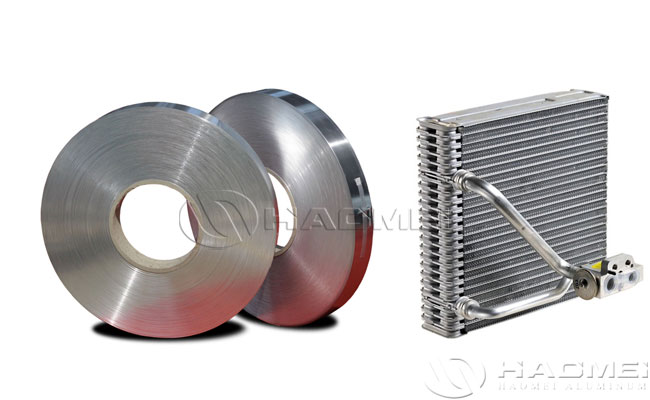
From a material properties perspective, our 1060 pure aluminum strip has an aluminum content of ≥99.6%, and is processed through an 8-pass cold rolling process, ensuring a stable grain size of grade 8 or higher. This results in a thermal conductivity of 238 W/(m·K), 5%-8% higher than ordinary products in the industry. For commercial air conditioning applications requiring higher strength, our 3003 aluminum strip, with a precise Mn content (1.0%-1.5%), maintains a thermal conductivity of 201 W/(m·K) while increasing tensile strength to 145 MPa. This reduces the likelihood of deformation and cracking after fin formation, making it particularly suitable for high-pressure evaporator structures.
Regarding surface treatment, we have broken through the traditional single passivation technology, developing a three-step process of "degreasing-pickling-composite passivation." This forms a 2-3 μm thick Cr-Free passivation film on the finished product surface. Salt spray testing shows a neutral salt spray tolerance time of over 72 hours, significantly improved compared to the industry standard of 48 hours, effectively solving the corrosion problem of evaporators in humid environments. Meanwhile, the surface tension of the passivation film is controlled at 32-36 mN/m, increasing the adhesion with the hydrophilic coating by 30%. The coating adhesion reaches Grade 1 of GB/T 9286-1998 standard, preventing heat exchange efficiency degradation caused by coating peeling after long-term use.
Regarding forming precision, we introduced a German-imported four-roll cold rolling mill, controlling the strip thickness tolerance within ±0.005mm and the flatness ≤2I. This ensures that the window opening rate error during fin stamping is controlled within 1%, guaranteeing the uniformity of refrigerant flow through the fins. Furthermore, through optimization of the online continuous annealing process temperature profile (annealing temperature 320℃±5℃, holding time 12 seconds), the yield strength of the aluminum strip is stabilized at 45-55MPa, meeting the forming requirements of high-speed fin stamping (1200 times per minute) while avoiding stamping fracture due to excessive material brittleness.
Actual application data shows that air conditioning products using our evaporator aluminum strips have a 12% higher heat exchange efficiency than similar products using ordinary aluminum strips. Under the operating conditions specified in the national standard GB/T 7725-2022, the cooling power is reduced by 8%. Furthermore, after 5,000 hours of continuous operation testing, the fins showed no obvious corrosion or deformation, fully verifying the reliability and economy of the product.-
- pre:pre:Wide Application of Painted Aluminum Strip
- Next:next:Where to Buy 7075 Aluminium plate?
- Haomei aluminum
- haomei Aluminium Plate