


-
- News Center
- Related News
-
- Aluminum Circles for Pots
- 2015 Haomei Annual Meeting of the New Year
- Haomei Aluminum speci
-
- Home > News > Industry news >
- Aluminum Circles for Pots
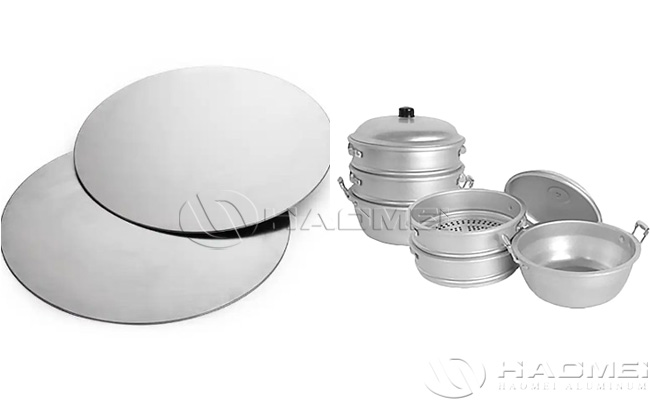
Haomei Aluminum specializes in supplying aluminum circles for pots, which are primarily used to produce non-stick pans, frying pans, woks, soup pots, saucepans, pressure cooker liners, steamers, baking molds, and various other kitchenware items. Produced from aluminum sheets coils, aluminum circles undergo processes such as leveling, blanking (circular cutting), edge trimming, annealing, and inspection. They are designed to meet the demands of deep drawing, shallow drawing, spinning, stamping, curling, base bonding, and surface coating.
Cookware manufacturing places specific demands on aluminum circles regarding plasticity, grain structure, thickness uniformity, surface cleanliness, and edge quality. During the drawing process, the aluminum circles must withstand significant plastic deformation; issues such as uneven "earing," cracking, "orange peel" effects, wrinkling, and thinning of the pot base can arise if the material is too hard, has coarse grains, features rough edges (burrs), or exhibits significant thickness fluctuations. Through precise control of alloy composition, annealing processes, and blanking operations, Haomei Aluminum provides cookware manufacturers with aluminum circles that offer consistent forming performance.
Aluminum circles for cooking pots typically utilize 1000 series pure aluminum and 3000 series aluminum-manganese alloys. The specific choice depends on the cookware's design, forming depth, strength requirements, and intended surface treatment.
Among them, 1060 aluminum circle is widely used as the base material for standard aluminum pots, frying pans, soup pots, and non-stick cookware. This series offers excellent thermal conductivity, ductility, corrosion resistance, and suitability for anodizing, making it ideal for deep drawing, general drawing, and spinning processes.
1100 aluminum circles contain trace amounts of copper, offering good workability and corrosion resistance; they are suitable for general kitchenware, baking molds, and stamped products.
3003 aluminum circles provides higher strength than the 1000-series pure aluminum. This material is ideal for cookware requiring greater rigidity, deformation resistance, and structural strength—such as thick-walled stir-fry pans, commercial cookware, pressure cooker components, and pans with composite bases.
Haomei Aluminum offers aluminum circles for cookware in both standard and custom sizes, with common thicknesses ranging from 0.30 mm to 6.00 mm and diameters from 100 mm to 1,200 mm. Aluminum circles for cookware are primarily supplied in the O-temper (fully annealed) state. Materials in the O-temper state feature lower hardness and higher elongation, making them suitable for deep drawing and complex spinning processes. For products requiring shallow stamping, minimal forming, or specific rigidity, strain-hardened tempers such as H12 or H14 are also available.
Aluminum circles for cookware are typically supplied with a "Mill Finish" (as-rolled) surface. The finished product must be clean and flat, free from oil stains, scratches, dents, corrosion spots, edge cracks, delamination, or significant color variations that could affect processing or appearance. Materials intended for non-stick coated, hard-anodized, or polished cookware require stricter standards regarding surface cleanliness and microstructural uniformity.
For standard non-stick pans, saucepans, and soup pots, 1050 or 1060-O aluminum circles are recommended. If greater body rigidity, a thicker base, or superior deformation resistance is required, 3003-O aluminum circles are a suitable choice. For induction-compatible cookware, the aluminum circle is typically paired with a 430 stainless steel magnetic base plate or another composite base structure, with the aluminum serving primarily to conduct heat and form the pot body.
Haomei Aluminum offers customized aluminum circle solutions based on specific cookware types, drawing depths, thicknesses, diameters, surface finishes, and export packaging requirements. Consistent material properties and strict dimensional control help reduce the scrap rate during stamping while enhancing manufacturing efficiency and product consistency.-
- pre:pre:Aluminum Circles For Spinning
- Next:next:none
- Haomei aluminum
- haomei Aluminium Plate