


-
- News Center
- Related News
-
- Hard Aluminum Sheets
- 2015 Haomei Annual Meeting of the New Year
- Hard aluminum sheets
-
- Home > News > Industry news >
- Soft Aluminum Sheets
Soft aluminum sheets (industry standard code O temper, i.e., fully annealed state) represent the category with the highest plasticity and forming limit among all aluminum sheet delivery tempers. Their core value lies in eliminating all work hardening through a complete recrystallization process, endowing the material with extreme cold deformation capabilities. This makes them an irreplaceable basic substrate for deep drawing, stretching, and complex bending production scenarios. Many industry professionals equate soft aluminum sheets with low-strength, low-end sheets; in reality, they are functional products specifically optimized for high-precision forming processes. Forming yield directly determines downstream production efficiency, making them a core category we focus on for overseas stamping, kitchenware, and hardware clients.
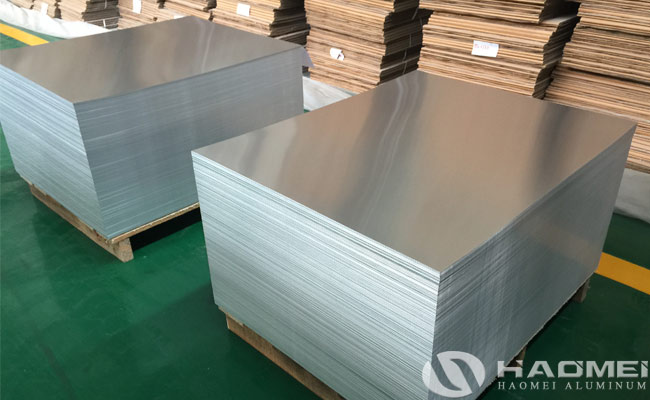
The core process of standard soft aluminium sheets is complete recrystallization annealing, which is also the essential guarantee of their stable performance. Our soft aluminum sheets are batch-annealed in a controlled atmosphere furnace within the 340℃~410℃ range after cold rolling. Sufficient holding time allows the grains to complete recrystallization, followed by slow cooling in the furnace, completely eliminating work hardening and internal stress generated during cold rolling. Unlike some manufacturers on the market that use low-temperature, short-time annealing to achieve a "pseudo-soft state," standard O temper aluminum sheets have uniform and fine internal grains, no residual stress concentration, and a full-width performance deviation of ≤5%. They do not exhibit localized cracking or uneven springback during bending and stretching, perfectly meeting the stability requirements of automated mass production.
The performance gradients of soft temper aluminum sheets from different alloy systems are clear, allowing for precise matching to varying forming difficulties and working conditions.
Pure aluminum 1060-O offers the best formability, with a tensile strength of 90-120 MPa, elongation after fracture ≥35%, and cupping value ≥10 mm, making it suitable for extreme forming applications such as deep drawing and spinning.
3003 O rust-resistant aluminum balances formability and corrosion resistance, with a tensile strength of 110-150 MPa and elongation after fracture ≥30%, making it the mainstream choice for kitchenware, cans, and sheet metal bending.
5052-O medium-strength rust-resistant aluminum retains basic corrosion resistance even in its soft state, with a tensile strength of 170-220 MPa and elongation after fracture ≥20%, suitable for corrosion-resistant parts requiring medium-depth stamping.
Regarding dimensional accuracy, the tolerance for a thickness range of 0.5-3.0 mm is controlled within ±0.04 mm, and the surface is covered with a PE protective film by default to prevent scratches during transportation and processing.
The core of selecting soft aluminum sheets lies in matching the forming difficulty and service conditions, rather than blindly pursuing the highest ductility.
For deep-drawn products with large deformation, such as aluminum kitchenware and lamp shades, 1060-O or 1100-O are preferred to ensure no cracking during stretching.
For chemical tank heads and coastal sheet metal parts, where both formability and corrosion resistance are important, 3003-O is the optimal solution.
For corrosion-resistant automotive structural parts and ship internal stamping parts, 5052-O can retain sufficient structural strength after forming.
A common industry misconception is to anneal ordinary H-tempered sheets instead of standard O-tempered sheets. This practice easily leads to problems such as uneven hardness, surface oxidation color differences, and unstable performance. The scrap rate in mass production can increase by more than 10%. For standardized industrial production, it is recommended to use original manufacturer normalized O-tempered products.
Haomei soft aluminum sheets cover the full range of mainstream alloys and specifications, with thicknesses ranging from 0.2mm to 6.0mm and widths supporting custom slitting from 100mm to 2000mm. They are available in both coil and sheet form. Our products are manufactured in strict accordance with ASTM B209 and EN 485 international standards. Each batch undergoes hardness testing and elongation sampling, and customized testing services such as cupping tests are available. For export applications, we use vertical wooden pallets with moisture-proof film packaging, along with complete material certificates and test reports, providing overseas kitchenware, hardware, and automotive parts customers with a stable, high-yield, one-stop supply solution for soft aluminum materials.-
- pre:pre:Latest 5083 Aluminum Sheet Price In Dollars
- Next:next:Hard Aluminum Sheets
- Haomei aluminum
- haomei Aluminium Plate