-
-
- Half Hard Temper Aluminum Sheets
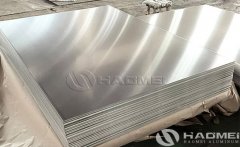
- Half hard aluminum sheets represent the most "neutral" yet practical category in the aluminum sheet hardening system. Corresponding to industry standard 1/2 hardening grades such as H14, H24, and H34, its core strength lies in finding a performance balance between the high plasticity of the soft temper and the high strength of the hard temper through precise control of cold rolling deformation and annealing processes. In Haomei Aluminum's years of experience working with overseas sheet metal and hardware clients, approximately 70% of processing scenarios requiring bending and shallow stretching ultimately choose half hard temper aluminum sheet products. They avoid the tendency to collapse and deform after forming like soft aluminum sheets, and also avoid the cracking and uncontrolled springback issues of fully hard aluminum sheets. They represent a "golden middle ground" that balances processing yield and finished product strength.'
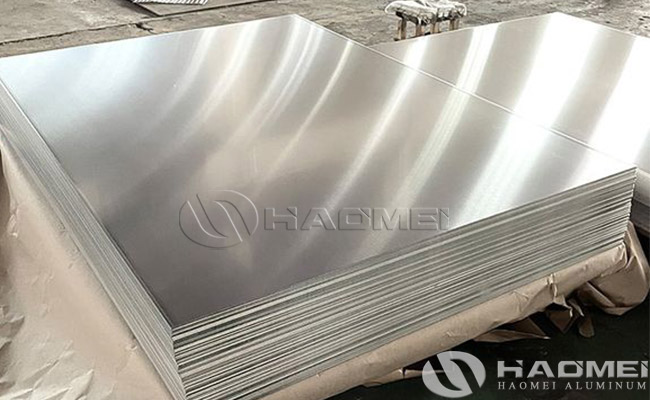
From a process logic perspective, half hard is not simply "rolled to half hardness," but rather involves a clear standard path differentiation, a detail that often confuses procurement. Of the two most commonly used half hard tempers on the market, H14 is purely cold-rolled work-hardened, achieving a semi-hardness level through approximately 50% cold deformation. Its process is simple and cost-effective, suitable for simple bending and punching scenarios. H24, on the other hand, involves an additional low-temperature partial annealing process after cold-rolling hardening to eliminate some residual internal stress, achieving a strength retention rate of over 90%. It also boasts superior plasticity and dimensional stability, with approximately 15% lower springback during bending compared to H14. We typically advise customers: for ordinary flat plate cutting and single-pass 90° bending, H14 is sufficient to control costs; for multi-pass bending and precision sheet metal parts requiring high dimensional accuracy, H24 is the preferred choice. While it may seem only a few tens of dollars more per ton, the improved yield in mass production more than compensates for the price difference.
The half hard properties of different alloy systems can be precisely matched to the performance requirements of different working conditions. 1060-H24 pure half hard aluminum sheet has a tensile strength of 110~140MPa, elongation after fracture ≥10%, Brinell hardness of approximately 35~45HB, and excellent electrical and thermal conductivity, making it suitable for heat sinks and shallow-drawn hardware. 3003-H14 rust-resistant half hard aluminum sheet is a general-purpose mainstay, with a tensile strength of 140~180MPa, yield strength ≥115MPa, elongation after fracture ≥8%, and stable rust resistance, making it a standard for chassis, cabinets, ventilation ducts, and architectural decoration. 5052-H34 medium-strength rust-resistant half hard aluminum sheet has a tensile strength of 230~280MPa, yield strength ≥195MPa, elongation after fracture ≥10%, and strength close to ordinary low-carbon steel while being resistant to salt spray corrosion, making it suitable for outdoor equipment housings and marine interior sheet metal. In terms of dimensional accuracy, the tolerance for standard thicknesses of 0.5~3.0mm is controlled within ±0.04mm, the flatness of the sheet is ≤1I, and the hardness deviation within the same roll is ≤±3HB, ensuring consistency in automated batch processing.
The core application value of half hard aluminum sheets lies in their optimal overall cost in mass production scenarios. For products like electronic chassis and electrical cabinet housings, using soft aluminum sheets results in poor dent resistance and easy deformation during transportation and installation; using fully hard aluminum sheets leads to cracking at bends and uneven assembly gaps due to significant springback. Half hard aluminum sheets strike a balance between the two, providing stable angles after bending and sufficient resistance to deformation, making them the default choice in the sheet metal industry. Half hard temper aluminum sheets are also commonly used in the architectural decoration field for aluminum ceiling panels, curtain wall backing panels, and decorative moldings, ensuring stamping accuracy while preventing warping and collapse after installation. We have actually calculated that, for the same specifications of 3003 half hard aluminium sheet metal used in standard chassis processing, the overall yield is about 10% higher than that of soft sheet metal, the rework rate is reduced by nearly 60%, and the overall cost is lower.
Of course, half hard aluminum sheet metal also has clear application boundaries. It is not suitable for processes with large deformation such as deep stretching and spinning, which still require soft aluminum sheet metal support; nor can it replace fully hard aluminum sheet metal for high-rigidity springs and load-bearing structural components. In fact, the forming capabilities of half hard aluminum sheet metal vary greatly depending on the thickness and alloy, and must be matched with specific processing techniques.
Haomei Aluminum's half hard aluminum sheets cover the 1xxx series, 3xxx series, and 5xxx series alloy systems, with thicknesses ranging from 0.2mm to 6.0mm, supporting various delivery forms such as coils, flat sheets, and slit strips. Each batch undergoes random sampling for hardness and elongation, ensuring stable and controllable performance. We will provide precise selection suggestions based on the customer's processing procedures and finished product requirements, helping customers achieve the optimal balance between processing efficiency and cost while ensuring quality.
Return list
-
- COPYRIGHT (C)2020 Haomei Aluminum. All Rights Reserved.
-